Asundexian
Clinical Trials on Secondary Stroke Prevention
SUMMARY
The efficacy and safety of asundexian for secondary stroke prevention have been assessed in the completed dose-finding Phase II PACIFIC-STROKE trial1 and the Phase III OCEANIC-STROKE trial2,3.
In the Phase II PACIFIC-STROKE trial, treatment effects were assessed in 1808 acute noncardioembolic ischemic stroke patients randomized to asundexian (10 mg, 20 mg or 50 mg once daily [OD]) vs placebo, in combination with antiplatelet therapy. Asundexian did not reduce the primary composite endpoint of covert brain infarction or ischemic stroke and did not increase the primary safety endpoint of major or clinically relevant non-major bleeding. In the exploratory post-hoc analysis, treatment with asundexian 50 mg OD was associated with a lower risk of the composite of recurrent symptomatic ischemic stroke and transient ischemic attack (TIA) vs. placebo. This observed relative risk reduction was greater among patients with underlying atherosclerosis.1 These Phase II findings informed the selection of the study population and the dose selection for the Phase III OCEANICSTROKE trial.1,2
This page is intended for US healthcare professionals and may contain information about or related to investigational compounds that have not been approved by the U.S. Food and Drug Administration. It is provided in response to an unsolicited request.
OCEANIC-STROKE was a multicenter, international, randomized, placebo-controlled, double-blind, parallel-group, event-driven Phase III study investigating the efficacy and safety of asundexian 50 mg OD compared with placebo, in combination with antiplatelet therapy, for the prevention of ischemic stroke in 12 327 patients after an acute noncardioembolic ischemic stroke or high-risk TIA.2-4 Asundexian significantly reduced ischemic stroke by 26% (cause-specific hazard ratio [csHR] 0.74; 95% confidence interval [CI] 0.65–0.84; P <0.001), without an increase in International Society on Thrombosis and Haemostasis (ISTH) major bleeding. This effect was seen early and sustained over time compared to placebo.3,4
CLINICAL DATA
Phase II study1
PACIFIC-STROKE was a randomized, placebo-controlled, double-blind, parallel-group, Phase IIb dose-finding trial evaluating the dose-response relationship for efficacy and bleeding profile of asundexian compared with placebo, in combination with single (SAPT) or dual (DAPT) antiplatelet therapy, in patients with an acute noncardioembolic ischemic stroke. The primary efficacy endpoint was the composite of symptomatic recurrent ischemic stroke and covert brain infarcts detected by magnetic resonance imaging (MRI), and the primary safety endpoint was ISTH major bleeding and clinically relevant non-major bleeding (CRNMB). Patients with acute (within 48 hours) noncardioembolic ischemic stroke were eligible if they were aged 45 years or older, were treated with antiplatelet therapy, and were able to have a baseline MRI (either before or within 72 hours of randomization).
A total of 1808 patients within 48 hours after the onset of the symptoms were randomly assigned (1:1:1:1) to asundexian 10 mg, 20 mg, or 50 mg OD tablets or placebo, in combination with SAPT or DAPT, and were followed up for a median of 46 weeks.
Mean age was 67 years (standard deviation [SD] 10) and 615 (34%) patients were women. The mean time from index stroke to randomization was 36 hours (SD 10), and the median baseline National Institutes of Health Stroke Scale score was 2.0 (interquartile range [IQR] 1.0–4.0). About 783 (43%) patients received DAPT for a mean duration of 70.1 days (SD 113.4) after randomization.
At 26 weeks, the primary efficacy outcome was observed in 87 (19%) of 456 patients in the placebo group vs 86 (19%) of 455 in the asundexian 10 mg group (crude incidence ratio 0.99 [90% CI 0.79–1.24]), 99 (22%) of 450 in the asundexian 20 mg group (1.15 [0.93–1.43]), and 90 (20%) of 447 in the asundexian 50 mg group (1.06 [0.85–1.32]; t statistic –0.68; P = 0.80). Asundexian did not reduce the composite primary outcome of symptomatic recurrent ischemic stroke and incident covert brain infarcts on MRI in a dose-dependent manner.
The primary safety outcome was observed in 11 (2%) of 452 patients in the placebo group vs. 19 (4%) of 445 in the asundexian 10 mg group, 14 (3%) of 446 in the asundexian 20 mg group, and 19 (4%) of 443 in the asundexian 50 mg group (all asundexian doses pooled vs. placebo HR 1.57 [90% CI 0.91–2.71]), indicating asundexian did not increase the risk of major or clinically relevant non-major bleeding.
In post-hoc exploratory analyses, treatment with asundexian 50 mg OD reduced the clinical outcome of recurrent symptomatic ischemic stroke and TIA (HR 0.64; 90% CI 0.41–0.98), and this reduction was increased in patients with underlying atherosclerosis (HR 0.39; 90% CI 0.18–0.85).
Phase III study
OCEANIC-STROKE was a multicenter, international, randomized, placebo-controlled, double-blind, parallel-group, event-driven Phase III study investigating the efficacy and safety of asundexian 50 mg OD (n=6162) compared with placebo (n=6165), in combination with antiplatelet therapy, for prevention of ischemic stroke in 12 327 patients after an acute noncardioembolic ischemic stroke or high-risk TIA.2-4 Asundexian or matching placebo was continued throughout the treatment period for a minimum of 3 months and a maximum of 31 months (see Figure 1). Patients were followed at 1 and 3 months, and subsequently at 3- month intervals, with all patients monitored to trial completion regardless of their medication status.2,3
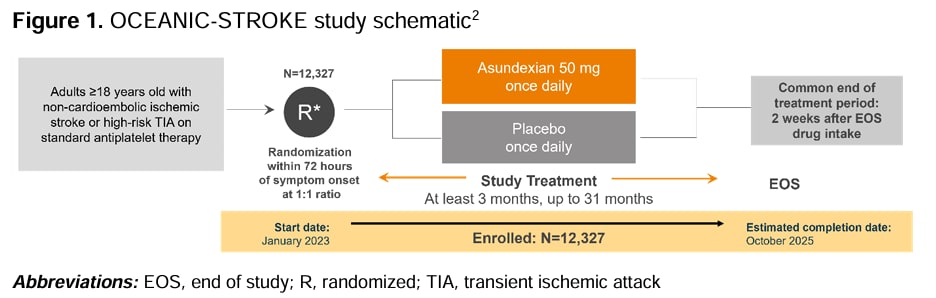
The primary efficacy endpoint was time to first occurrence of ischemic stroke. The primary safety endpoint was time to first occurrence of ISTH major bleeding, defined as fatal bleeding, symptomatic bleeding in a critical area or organ, or clinically overt bleeding that resulted in a hemoglobin decrease of at least 2 g/dL or led to the transfusion of at least 2 units of packed red cells or whole blood. The key inclusion and exclusion criteria are summarized in Table 1.2,3
Table 1. OCEANIC STROKE eligibility requirements3,5
| Key inclusion criteria | Key exclusion criteria |
|---|---|
|
|
Abbreviations: ABCD2 , age, blood pressure, clinical features, duration of symptoms, and diabetes; CMB, cerebral microbleed; GI, gastrointestinal; NIHSS, National Institutes of Health Stroke Scale; TIA, transient ischemic attack
The mean age (SD) of patients in the OCEANIC-STROKE study was 68 (10.8) years. There were 4110 (33.3%) female patients. DAPT (acetylsalicylic acid and a P2Y12 inhibitor) was given to 7712 (62.6%) patients and SAPT in 4613 (37.4%) patients as standard of care following randomization. Of the total population randomized, 3201 (27.4%) patients received intravenous thrombolysis, endovascular therapy, or both. The study included patients across Trial of ORG 10172 in Acute Stroke Treatment (TOAST) stroke subtypes, ensuring comprehensive representation of stroke etiologies. Table 2 presents both the baseline demographics and index event characteristics of the patients.3
Table 2. Participant demographics2,3
| Characteristics | Participants n (%) |
|---|---|
| Previous history of stroke or TIA | 2633 (21.4) |
| Coronary artery disease | 1945 (15.8) |
| Hypertension | 9780 (79.3) |
| Diabetes mellitus | 4238 (34.4) |
| Current smoker | 3309 (26.8) |
| Index event | |
| Ischemic stroke | 11 676 (94.7) |
| TIA | 649 (5.3) |
| TOAST Subtype of index event | |
| Large-artery atherosclerosis | 5028 (43.1) |
| Stroke of undetermined etiology | 3504 (30.0) |
| Small-vessel occlusion | 2591 (22.2) |
| Stroke of other etiology | 358 (3.1) |
| Cardioembolism | 193 (1.7) |
| NIHSS at presentation* | |
| Median (min, max) | 3 (0, 39) |
| Median (IQR) | 3 (2, 6) |
| NIHSS at randomization* | |
| Median (min, max) | 2 (0, 26) |
| Median (IQR) | 2 (1, 4) |
Abbreviations: IQR, interquartile range; max, maximum; min, minimum; NIHSS, National Institutes of Health Stroke Scale; TIA, transient ischemic attack; TOAST, Trial of ORG 10 172 in Acute Stroke Treatment
*Applies only to ischemic stroke.
In terms of the geographic distribution of participants in OCEANIC-STROKE, the majority of enrolled participants were from Western Europe (Table 3).3
Table 3. Geographic distribution of the OCEANIC-STROKE study population2,3
| Geographic Region | Participants n (%) |
|---|---|
| Western Europe* | 4844 (39.3) |
| Asia | 3528 (28.6) |
| Eastern Europe | 1823 (14.8) |
| North America | 1565 (12.7) |
| South America | 567 (4.6) |
*Includes Australia and Israel.
Source: Tables above were adapted from Sharma M, et al. Rationale, design and baseline characteristics of participants in the OCEANIC-STROKE trial of FXIa inhibition for secondary stroke prevention. [Downloaded 10 May 2026]. Copyright remains with the original source or as denoted therein
Results3,4
- Asundexian 50 mg OD significantly reduced ischemic stroke by 26% compared to placebo (384 [6.2%] vs. 518 [8.4%]; csHR 0.74; 95% CI 0.65-0.84; P <0.001). The benefit of reduced ischemic stroke for asundexian began early and was sustained throughout the study period.
- Ischemic or hemorrhagic stroke occurred in 404 patients (6.6%) in the asundexian group compared with 545 (8.8%) in the placebo group (csHR 0.74; 95% CI 0.65-0.84; P <0.001). Patients in the asundexian group also had a lower risk of the composite of cardiovascular (CV) death, myocardial infarction (MI), or stroke than those receiving placebo (568 [9.2%] vs. 685 [11.1%]; csHR 0.83; 95% CI 0.74–0.92; P <0.001). The incidence of disabling or fatal stroke was 2.1% in the asundexian group and 3.0% in the placebo group (csHR 0.69; 95% CI 0.55-0.87).
- There was no significant increase in ISTH major bleeding between treatment groups, occurring in 1.9% of patients receiving asundexian and 1.7% receiving placebo (csHR 1.10; 95% CI 0.85–1.44; P = 0.46). Rates of ISTH major or clinically relevant non‑major bleeding, CRNMB alone, symptomatic intracranial hemorrhage, hemorrhagic stroke, fatal bleeding, and minor bleeding were also similar between asundexian and placebo treatment groups.
All three composite endpoints for net clinical benefit favored asundexian (see Table 4). The risk of the composite outcome of ischemic stroke or ISTH major bleeding was lower with asundexian (430 [7.0%]) compared to placebo (529 [8.6%]) (csHR 0.82; 95% CI 0.72– 0.93). Similar reductions were seen for the composite outcome of CV death, all stroke, MI, or ISTH major bleeding (518 [8.5%] vs 611 [10.0%]; csHR 0.85; 95% CI 0.76–0.96) and the composite outcome of all-cause mortality, disabling stroke, fatal bleeding, or symptomatic ICH (189 [3.1%] vs. 234 [3.8%]; csHR 0.81; 95% CI 0.67–0.99).
Table 4. Net clinical benefit3,4
| Placebo (n=6130) | Asundexian 50 mg (n=6124) | ||||||
| Outcome | n (%) | n/100 p-years (95% CI) | CUIN at Year 1 (95% CI) | n (%) | n/100 p-years (95% CI) | CUIN at Year 1 (95% CI) | Cause-specific HR (95% CI) |
| Composite of ischemic stroke or ISTH major bleeding | 529 (8.6) | 7.6 (7.0-8.3) | 7.6 (6.9-8.3) | 430 (7.0) | 6.3 (5.7-6.9) | 6.1 (5.5-6.7) | 0.82 (0.72-0.93) |
| Composite of CV death, all stroke, MI, or ISTH major bleeding | 611 (10.0) | 8.8 (8.2-9.6) | 8.8 (8.1-9.5) | 518 (8.5) | 7.6 (6.9-8.2) | 7.3 (6.6-8.0) | 0.85 (0.76-0.96) |
| Composite of all-cause mortality, disabling stroke, fatal bleeding, or symptomatic ICH | 234 (3.8) | 3.3 (2.9-3.7) | 3.3 (2.9-3.8) | 189 (3.1) | 2.7 (2.3-3.1) | 2.5 (2.2-3.0) | 0.81 (0.67-0.99) |
*Confidence intervals are unadjusted for multiplicity and may not be used for inference. †Cause-specific hazard ratios are estimated from stratified Cox proportional hazards model (stratified by baseline intention of DAPT). Safety analysis set, treatment emergent analysis using planned treatment, death, and premature discontinuation as competing risks
Abbreviations: CI, confidence interval; CUIN, cumulative incidence; CV, cardiovascular; DAPT, dual antiplatelet therapy; HR, hazard ratio; ICH, intracranial hemorrhage; ISTH, International Society on Thrombosis and Hemostasis; MI, myocardial infarction; p-yrs, person-years
Source: Table 4 was published in Sharma M, et al. Asundexian for Secondary Stroke Prevention. [Downloaded on 10th May 2026]. Copyright remains with the original source or as denoted therein.
LITERATURE SEARCH
A literature search of Embase®, PubMed® , and/or other external and internal resources was conducted pertaining to this topic on 10 May 2026.
REFERENCES
All the references were accessed on the literature search date.
- Shoamanesh A, Mundl H, Smith EE, et al. Factor XIa inhibition with asundexian after acute non-cardioembolic ischaemic stroke (PACIFIC-Stroke): an international, randomised, double-blind, placebo-controlled, phase 2b trial. Lancet. 2022;400(10357):997–1007. PMID: 36063821 https://www.ncbi.nlm.nih.gov/pubmed/36063821
- Sharma M, Dong Q, Hirano T, et al. Rationale, design and baseline characteristics of participants in the OCEANIC-STROKE trial of FXIa inhibition for secondary stroke prevention. Eur Stroke J. 2026;11(1)PMID: 41614533 https://academic.oup.com/esj/article/11/1/aakaf017/8407782
- Sharma M, Dong Q, Hirano T, et al. Asundexian for Secondary Stroke Prevention. N Engl J Med. 2026;394(15):1467–1479. PMID: 41985132 https://www.ncbi.nlm.nih.gov/pubmed/41985132
- Supplement to: Sharma M, Dong Q, Hirano T, et al. Asundexian for secondary stroke prevention. N Engl J Med. 2026;394(15):1467–1479. PMID: 41985132 https://www.nejm.org/doi/suppl/10.1056/NEJMoa2513880/suppl_file/nejmoa2513880_a ppendix.pdf
- Protocol for: Sharma M, Dong Q, Hirano T, et al. Asundexian for Secondary Stroke Prevention. N Engl J Med. 2026;394(15):1467–1479. PMID: 41985132 https://www.nejm.org/doi/suppl/10.1056/NEJMoa2513880/suppl_file/nejmoa2513880_protocol.pdf


Follow Us