Asundexian
Effects of Food
SUMMARY
The effect of food on the pharmacokinetics (PK) of asundexian, an oral Factor XIa (FXIa) inhibitor, has been evaluated in clinical studies in healthy individuals.1,2
The absolute bioavailability of asundexian and the impact of gastric pH, tablet formulation, and food on its PK and safety were evaluated in healthy participants in 4 studies. Formulation and food effects were specifically examined in study 2 (50-mg immediate-release [IR] vs. 25- mg amorphous solid dispersion [ASD] IR formulations, and 25-mg ASD IR tablet under fasted vs. fed states) and study 3 (25-mg ASD IR vs. 50-mg ASD IR formulations, and 50-mg ASD IR tablet under fasted vs. fed states).2
This page is intended for US healthcare professionals and may contain information about or related to investigational compounds that have not been approved by the U.S. Food and Drug Administration. It is provided in response to an unsolicited request.
- Data showed that neither food nor gastric pH modulation had a clinically relevant effect on asundexian bioavailability and PK, with point estimates and 90% confidence intervals (CIs) of all area under the concentration‐time curve divided by dose (AUC/D) ratios within the predefined no-effect range (80.0%–125.0% for the 50‐mg ASD IR tablet). The only parameters that slightly exceeded the lower no-effect boundary of 80% were the point estimate and lower limit of the 90% CI for the maximum observed concentration (Cmax) ratio investigating the food effect on the 25‐mg ASD IR formulation in study 2. Compared with the fasted state, consuming a high‐fat meal modestly delayed time to reach maximum plasma concentration (tmax) by approximately 1 hour (fasted, 3.9 hours; fed, 4.9 hours) and slightly reduced exposure (AUC and Cmax) for the 25‐mg ASD IR formulation. The tmax for the 50-mg formulation remained similar in both states (fed, 3.8 hours; fasted, 4.3 hours) (see Figure 1). These results informed dosing in clinical trials, indicating that asundexian can be taken independently of food.2
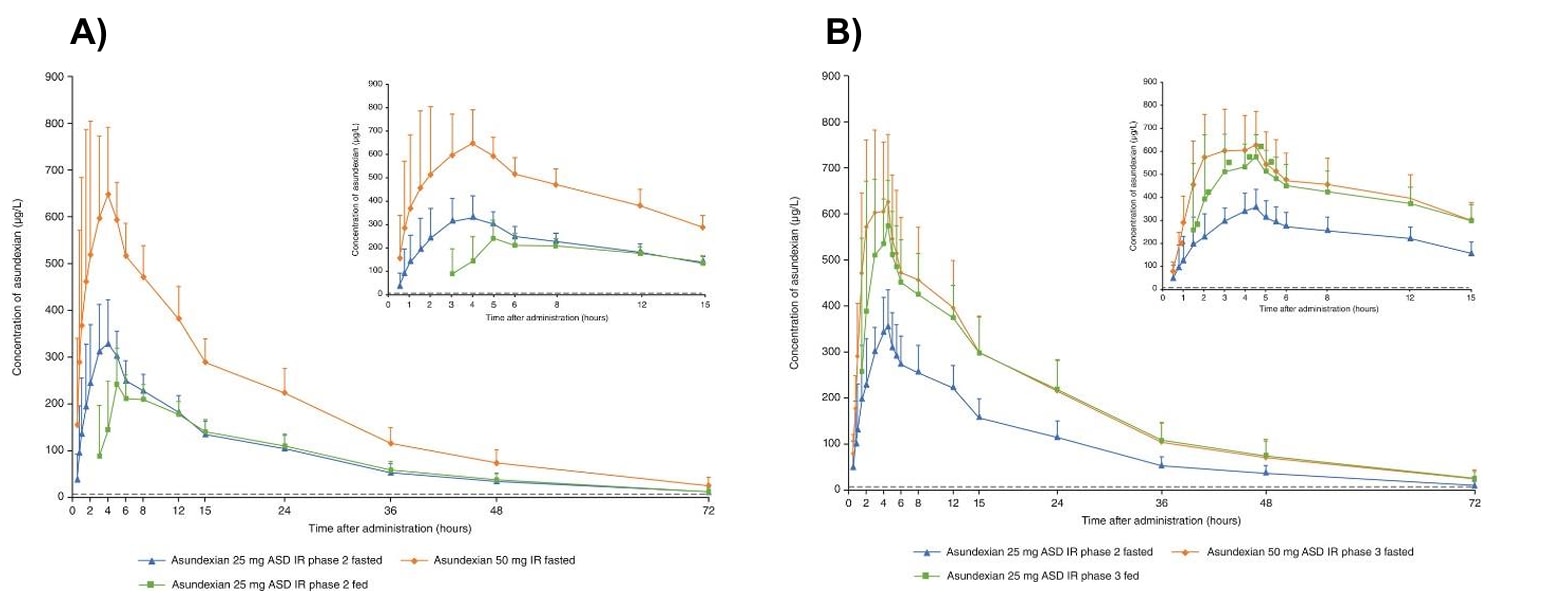
Figure 1. A) Mean (SD) plasma concentrations of asundexian after oral administration of asundexian 50-mg IR tablet in the fasted state; asundexian 25-mg ASD IR tablet in the fasted state; and asundexian 25-mg ASD IR tablet after a high-fat, high-calorie breakfast (n = 15). B) Mean (SD) plasma concentrations of asundexian after oral administration of asundexian 25-mg ASD IR tablet in the fasted state; asundexian 50-mg ASD IR tablet in the fasted state; and asundexian 50-mg ASD IR tablet 30 minutes after the start of a high-fat, high-calorie breakfast (n = 14).2
Abbreviations: ASD, amorphous solid dispersion; IR, immediate-release; SD, standard deviation.
Source: Figure 1 above was published in Kanefendt F, Brase C, Unger S, Kubitza D. Effects of Tablet Formulation, Food, or Gastric pH on the Bioavailability of Asundexian. Clin Pharmacol Drug Dev. 2023;12(2):219-230 [downloaded 20 November 2025]. Copyright remains with the original source or as denoted therein.
LITERATURE SEARCH
A literature search of Embase® and/or PubMed®, and/or other external and internal resources was conducted pertaining to this topic on the 10 March 2026.
REFERENCES
All the references were accessed on the literature search date.
- Edwards J, Corey J, Coons JC. Exploring the therapeutic utility of the factor XIa inhibitor asundexian. Am J Health Syst Pharm. 2024;81(24):1222–1229. PMID: 38995101 https://www.ncbi.nlm.nih.gov/pubmed/38995101
- Kanefendt F, Brase C, Unger S, Kubitza D. Effects of Tablet Formulation, Food, or Gastric pH on the Bioavailability of Asundexian. Clin Pharmacol Drug Dev. 2023;12(2):219–230. PMID: 36507617 https://www.ncbi.nlm.nih.gov/pubmed/36507617


Follow Us