Asundexian
Pharmacokinetic and Pharmacodynamic Profile
SUMMARY
- The pharmacokinetics (PK) and pharmacodynamics (PD) of asundexian have been evaluated in preclinical and clinical studies in healthy individuals.1-3
Asundexian undergoes metabolism primarily through carboxylesterase 1 (CES1; approximately 47%), with a smaller contribution from cytochrome P450 (CYP) 3A4 (approximately 13%), and is excreted unchanged (approximately 37%) via P-glycoprotein.4,5 It is not a substrate for the efflux transporters breast cancer resistance protein (BCRP), multidrug resistance-associated protein 2 (MRP2), or multidrug and toxin extrusion protein 1 (MATE1), nor for the uptake transporters organic anion transporting polypeptide 1B1 (OATP1B1) or organic anion transporting polypeptide 1B3 (OATP1B3).4 No clinically relevant inhibition or induction of CYP3A4 was observed. Preclinical in vitro data using human hepatocytes at clinically relevant plasma concentrations predicted asundexian to act as a weak-to-moderate inducer of sensitive CYP3A4 substrates, with a no-observed-effect level of 370 μg/ L.2
This page is intended for US healthcare professionals and may contain information about or related to investigational compounds that have not been approved by the U.S. Food and Drug Administration. It is provided in response to an unsolicited request.
- A Phase I, randomized, single-center, two-part study evaluated the safety, PK and PD of asundexian in healthy men. In Part 1 of the study, 70 volunteers were randomized 4:1 to receive a single oral dose of asundexian (5–150 mg as oral solution or immediate‐release [IR] tablets) or placebo. Asundexian showed rapid absorption (median time to maximum plasma concentration [tmax], 1.00 hour for oral solution and 2.50–3.97 hours for IR tablets), a 14.2– 17.4 hours geometric mean half-life [t½], low interindividual variability (geometric CV 16.1– 25.4%), dose‐proportional exposure, and high IR tablet bioavailability (area under the plasma concentration–time curve [AUC] 89.5%, maximum plasma concentration [Cmax] 86.0% versus oral solution).1
- Systemic exposure to asundexian (as measured by AUC and Cmax after the first dose and AUC within the dosing interval [AUCτ] and Cmax at steady state) in a Phase I multiple-dose study, appeared to increase in a dose-proportional manner between doses of 25 and 100 mg once daily (OD), with low-to-moderate variability in PK parameters. Mean t1/2 values for asundexian after multiple doses were 15.8–17.8 hours. Renal elimination of unchanged asundexian was only a minor route of elimination, with mean renal clearance ranging from 0.267 to 0.440 L/h (7.61% to 13.4%) after single-dose administration. Maximal inhibition of factor XIa (FXIa) activity was observed approximately 2–4 hours after administration of a single 25 mg dose of asundexian, while higher doses resulted in complete inhibition of FXIa activity.2
- A comparison of PK and PD data from Japanese and Chinese studies with previous Caucasian data revealed no clinically relevant differences in a Phase I, single-center, single and multiple-dose escalation studies. In 36 Chinese and 24 Japanese volunteers, systemic exposure to asundexian increased proportionally with dose after single or multiple administrations, showing low accumulation with OD dosing. Asundexian caused dose-dependent prolongation of activated partial thromboplastin time (aPTT) and inhibition of FXIa activity, without affecting prothrombin time or FXI concentration in Japanese participants. No clinically relevant interethnic differences were observed in the PK profile among Japanese, Chinese, and Caucasian participants, nor in the PD response between Japanese and Caucasian participants.3
CLINICAL DATA
Pharmacology studies
A Phase I, randomized, single-center, two-part study evaluated the safety, PK and PD of asundexian in healthy men. In Part 1 of the study (a single‐blind, parallel‐group, placebo‐ controlled, dose‐escalation study), 70 volunteers were randomized 4:1 to receive a single oral dose of asundexian (5–150 mg as oral solution or IR tablets) or placebo.1
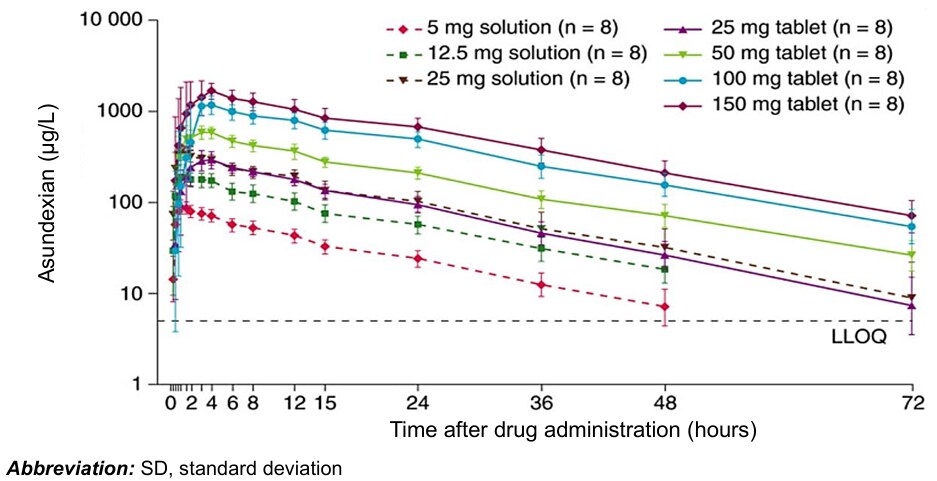
Asundexian was absorbed with a median tmax of 1.00 hour for the oral solution and 2.50 to 3.97 hours for the IR tablets in the fasted state. The geometric mean t½ ranged from 14.2 to 17.4 hours, and the apparent oral clearance (CL/F) was between 3.19 and 4.21 L/h. Interindividual variability in exposure was low, with a geometric coefficient of variation (CV) of 16.1% to 25.4%. In part 1, asundexian exposure increased dose-proportionally when administered as either an oral solution or IR tablets. High bioavailability was noted for the five 5-mg IR tablets compared with the oral solution, with AUC and Cmax values of 89.5% and 86.0%, respectively (Figure 1).1
Figure 1. Plasma concentration–time profile of asundexian in healthy volunteers in Part 1. Data are presented as geometric mean values. The lower and upper limits of the error bars are the geometric mean/geometric SD and the mean × geometric SD, respectively.1
Source: Figure 1 above was published as Figure 2 in Thomas D, et al. First evaluation of the safety, pharmacokinetics, and pharmacodynamics of BAY 2433334, a small molecule targeting coagulation factor XIa [downloaded on 12 February 2026]. Copyright remains with the original source or as denoted therein.
The safety, PK and PD of asundexian were evaluated in a randomized Phase I multiple-dose study in healthy male participants. The study was divided into three parts. Part A was a randomized, single-blind, placebo-controlled, multiple dose-escalation study assessing the safety, PK, and PD of OD asundexian. Part B followed a similar design to Part A but evaluated twice-daily (BID) dosing of one dose strength. Participants in Parts A and B (N = 48) were randomized to receive asundexian 25, 50 or 100 mg OD, 25 mg BID, or placebo.2
- On day 1 of Parts A and B, asundexian reached its median time to Cmax of 2.00 to 3.97 hours across all treatment groups. By day 12, after multiple doses, the median time to Cmax was 3.00 to 4.00 hours for OD dosing and 1.50 hours for BID dosing. The geometric mean terminal t1/2 of asundexian on day 1 was 14.0 to 15.9 hours and within a similar range (15.8–17.8 hours) on day 12, across all treatment groups. The arithmetic mean renal elimination (%AE,ur) of unchanged drug accounted for approximately 7.61–13.4% of the dose after single-dose administration and for approximately 10.1–13.5% after multiple dosing.
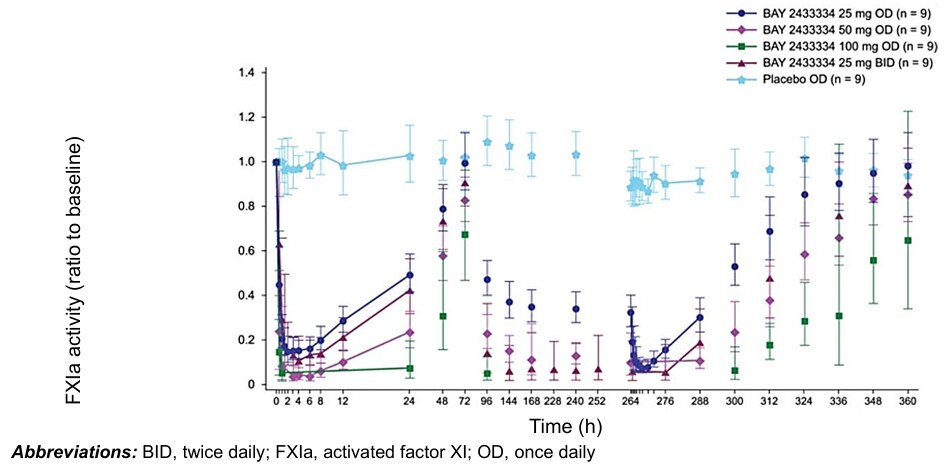
- In Parts A and B, a dose-dependent increase in aPTT was observed (Figure 2). Part A data indicated that all asundexian doses significantly prolonged aPTT compared to placebo (P <0.05 for all dose comparisons; asundexian 25–100 mg OD in Part A; Figure 2). The prolongation of aPTT was evident at the first time point (30 minutes post-dosing), with the maximum prolongation occurring approximately 4 hours after dosing. Asundexian led to a rapid, dose-dependent inhibition of FXIa activity, while placebo showed no effect (Figure 3). The maximum inhibition of FXIa activity was observed 1.5 to 4.0 hours after a single dose of asundexian, with residual FXIa activity levels at 10.6% for 25 mg OD and 6.7% for BID dosing.
Figure 2. Geometric mean (standard deviation) effect of asundexian on ratio to baseline of aPTT following OD treatment with asundexian 25–100 mg in Part A and BID treatment with asundexian 25 mg in Part B2
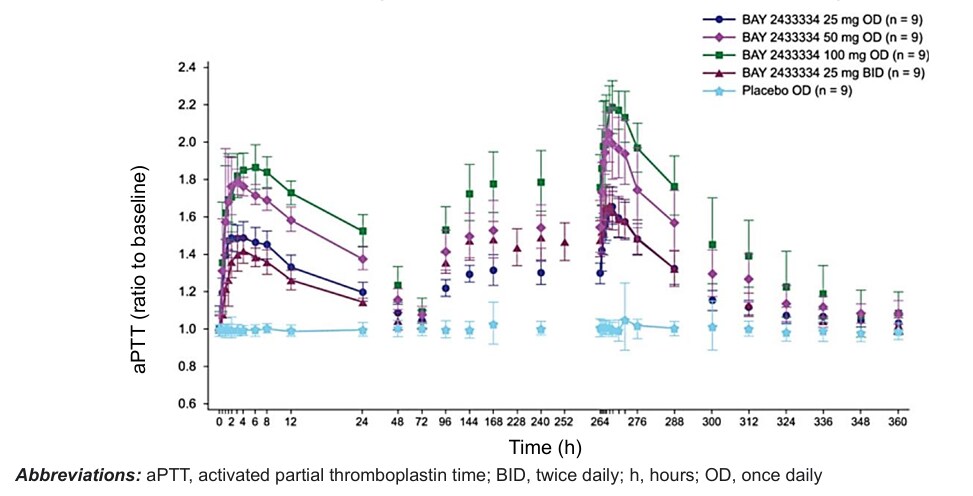
Figure 3. Geometric mean (standard deviation) effect of asundexian on ratio to baseline of FXIa activity. Asundexian 25–100 mg was given OD in Part A. In Part B, asundexian 25 mg was given BID (OD on days 1 and 12).2
Source: Figures 2 and 3 above were adapted from Kubitza D, et al. Pharmacokinetics, pharmacodynamics and safety of BAY 2433334, a novel activated factor XI inhibitor, in healthy volunteers: A randomized phase 1 multiple-dose study [downloaded on 12 February 2026]. Copyright remains with the original source or as denoted therein
Two Phase I, single-center, randomized, placebo-controlled studies were conducted to evaluate the safety, tolerability, PK, and PD of asundexian in healthy Japanese (n = 24) and Chinese (n = 36) men. The Japanese study involved single and multiple OD doses: participants were randomized (6:2) to receive a single dose followed by multiple OD doses of asundexian (25, 50, or 100 mg) or placebo. A single dose was given on day 1, followed by OD treatment for 5 days (days 4–8) after a 3-day washout. The Chinese study included three cohorts (25, 50, and 100 mg). Participants in the 25 and 50 mg cohorts were randomized (9:3) to receive a single dose of asundexian or placebo on day 1. In the 100 mg cohort, participants were randomized (9:3) to receive a single dose of asundexian or placebo on day 1, followed by OD dosing for 5 days (days 5–9) after a 4-day washout.3
- The geometric mean plasma concentration-time profiles of asundexian after a single dose and the last dose of multiple OD dosing were similar between Chinese and Japanese participants, with a slightly higher Cmax observed for the 100 mg dose in Japanese individuals. In both studies, asundexian was absorbed with a median tmax of 3.5–4.5 hours after a single dose and a median tmax for multiple dosing (tmax,md) of 3.0–4.0 hours after multiple doses. Geometric means for Cmax in measured matrix after single-dose administration divided by dose (Cmax/D) (range, 0.012–0.0168 h/L) and AUC/D (range, 0.319–0.380 h/L) after a single dose were comparable across all asundexian groups. Similarly, geometric means for Cmax after multipledosing divided by the dose (Cmax,md/D) (range, 0.0197–0.0256 h/L) and AUC within the dosing interval divided by dose (AUC(0–24)md/D) (range, 0.317–0.393 h/L) after multiple doses were consistent across all asundexian groups in both studies.
- In both studies, the terminal half-life of asundexian was similar after single and multiple dosing, with geometric mean values ranging from 15.2 to 18.6 hours (t½) and 15.6 to 17.9 hours (t½,md), respectively. The accumulation of asundexian was relatively low for Cmax and AUC after multiple OD dosing (RACmax: 1.32–1.61; RAAUC: 1.47–1.76). After 5 consecutive days of dosing, linearity factor of PK (RLIN) was 0.95–1.03 in both studies, indicating time-linear PK.
LITERATURE SEARCH
A literature search of Embase® and/or PubMed®, and/or other external and internal resources was conducted pertaining to this topic on the 10 March 2026.
REFERENCES
All the references were accessed on the literature search date
- Thomas D, Kanefendt F, Schwers S, Unger S, Yassen A, Boxnick S. First evaluation of the safety, pharmacokinetics, and pharmacodynamics of BAY 2433334, a small molecule targeting coagulation factor XIa. J Thromb Haemost. 2021;19(10):2407–2416. PMID: 34192419 https://www.ncbi.nlm.nih.gov/pubmed/34192419
- Kubitza D, Heckmann M, Distler J, Koechel A, Schwers S, Kanefendt F. Pharmacokinetics, pharmacodynamics and safety of BAY 2433334, a novel activated factor XI inhibitor, in healthy volunteers: A randomized phase 1 multiple-dose study. Br J Clin Pharmacol. 2022;88(7):3447–3462. PMID: 35014061 https://www.ncbi.nlm.nih.gov/pubmed/35014061
- Chen H, Hashizume K, Kanefendt F, Brase C, Schmitz S, Liu T. Pharmacokinetics, pharmacodynamics, and safety of asundexian in healthy Chinese and Japanese volunteers, and comparison with Caucasian data. Clin Transl Sci. 2024;17(8):e13895. PMID: 39082898 https://www.ncbi.nlm.nih.gov/pubmed/39082898
- Kanefendt F, Brase C, Jungmann N, Fricke R, Engelen A, Schmitz S. Pharmacokinetics of asundexian with combined CYP3A and P-gp inhibitors and an inducer: Target in vitro and in vivo studies. Br J Clin Pharmacol. 2023;PMID: 38048692 https://www.ncbi.nlm.nih.gov/pubmed/38048692
- Piel I, Engelen A, Lang D, et al. Metabolism and Disposition of the Novel Oral Factor XIa Inhibitor Asundexian in Rats and in Humans. Eur J Drug Metab Pharmacokinet. 2023;48(4):411–425. PMID: 37365440 https://www.ncbi.nlm.nih.gov/pubmed/37365440


Follow Us